30
Nov
The Tuf-Lugger Pulls Its Weight
The Tuf-Lugger cable puller is four-wheeled, maneuverable winch capable of pulling 2000lb in high gear, and up to a maximum load of 6500lb. Pulling tension will be determined by the duct geometry; while individual installations may not typically reach this force, it’s nice to have it when you need it.
The Tuf-Lugger has an on-board meter for measuring pulling tension, allowing you to monitor the load and make changes to the pull if needed. The calibrated Load Monitor System is an optional accessory to provide more accurate data (for fiber optic pulls, for example).
To increase the flexibility of the Tuf-Lugger, longer boom arms may be cut from standard Schedule 40 pipe or the Universal Extension can be used to rotate the pulling direction out of plane.
Underground: the Manhole Adapter can be used at the surface, combined with Sheaves or Quadrants anchored and hung in the vault itself. (Hanging Quadrants provide flexibility, since they can be moved and re-oriented within the vault.) A Duct Entry Guide is recommended to finally direct the cable into the duct.
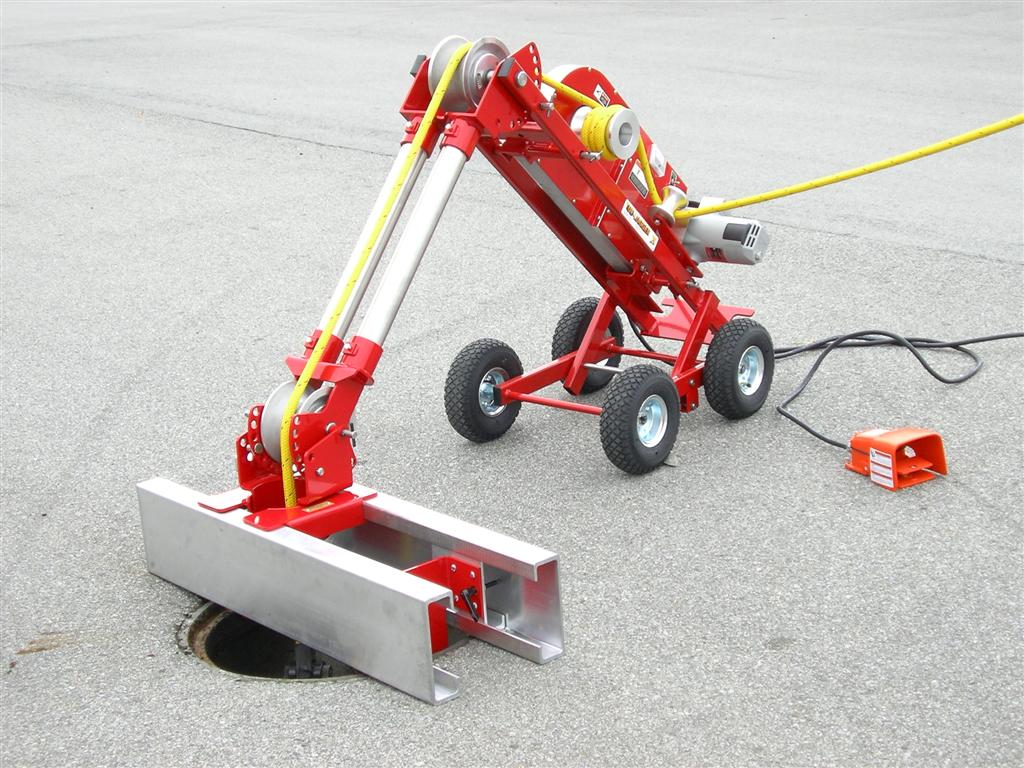
Keep in mind that the Tuf-Lugger is not pulling the cable itself. Lightweight pull tape is installed into the duct first, linking the cable reel at the inlet and the cable puller at the outlet. The Tuf-Lugger has open sheaves and a capstan winch to accept a variety of rope sizes (from 3/8” to 7/8” typically) – the rope is then pulled by the Tuf-Lugger, and as the rope is extracted from the duct, the cable is pulled into place.
If the calculated pulling tension is too high due to excessive length or bends in the duct, a lubricant like our Tube-Lube 326 would be recommended to mitigate the friction in the duct.
See our previous cable pulling post “A Team Effort” for even more information on the cable pulling equipment that DCD Design builds.
RELATED
Posts
23
Nov
Another Good Idea: Making Dewatering Easier
We took a call from a customer a few days ago. His 00650-150 puller wasn't broken, but neither was it gripping like it used to. As it turns out, Gary Fors and Designed Groundwater Services were applying...
5
Nov
Wire Mesh Grips and Catalog Strength
Wire mesh pulling grips, chinese fingers, pulling socks, stockings, support grips - whatever you call them, pulling grips are one of those tools that everybody uses for utility installations. Overhead, underground, through ducts and over sheaves, grips are...
10
Sep
Breakaway! - Another Duckt Production
The Duckt crew put together a great sales presentation for the DCD Breakaway Connectors, highlighting the quick assembly and range of breaking strengths available. The finished PowerPoint looked so good that we made a video clip as well,...
23
Jul
"I want to fly like an Ea-" Oh, that's copyright?
It's been a busy month: DCD Design have created a new how-to video for the Eagle Cable Lasher, demonstrating some of the features and showing you how to load the lashing wire. (This ties in to next month's...
21
May
Carnivorous Carrots!
Watch out for those innerduct pulling eyes - they've got sharp teeth!
We were making a short video for the various duct pulling tools last week: wire mesh grips, innerduct pulling eyes, the expanding shell pullers and the sealed...
22
Apr
Breaking Breakaway Pins
24
Mar
Working Loads for Line Swivels
DCD Design provides two Safe Working Load limits for our 00505 Series Line Swivels, depending on whether you're pulling Underground or Overhead. What's the difference? RISK.
Continue Reading This Post
11
Mar
Wire Grips - Free vs. Fitted Lengths
Inquiries for wire mesh pulling grips come in from all over the place, and it's interesting to see how local tradition will affect terminology.
The length of a grip depends on where you're standing. If you're reading a...
2
Mar
This Blows!
Pardon the pun, but how often do you get to say that in public?!
We’ve got a range of line-blowing products on special this month – mix and match to build a tool kit that works for you! All...
19
Feb
A New How-To for HDD Swivels
It's a fairly regular request we get these days, "I'm wondering if I should service my swivel. What should I look for?"
Servicing the equipment you have is bound to be cheaper than buying new - in most...