11
Mar
Wire Grips – Free vs. Fitted Lengths
Inquiries for wire mesh pulling grips come in from all over the place, and it’s interesting to see how local tradition will affect terminology.
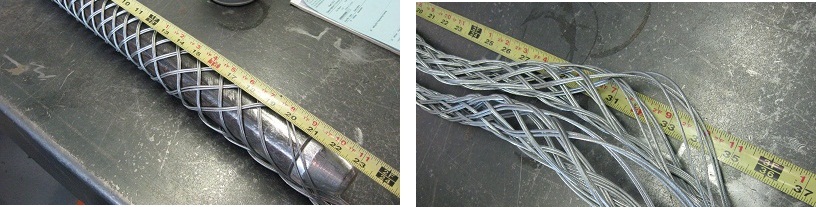
The length of a grip depends on where you’re standing. If you’re reading a North American catalog, the length of the mesh is taken at the grip’s nominal diameter. That is: it’s measured when it’s fitted around the cable it’s pulling. This is the engaged length of the grip; the eye and the overall length are measured separately.
Other locales will measure the “free length” of the grip, when it’s hanging on the wall. The free length can be half-again as long as the fitted length, so it’s not a clear indicator by itself of the size of the grip in service. The comparison below shows the difference: a free length of 35″ can contract the mesh to just 21″ when it’s installed.
The wire weave of a pulling grip is flexible, and the grip will contract as the tube diameter increases. Variation of a couple inches in the free length is typical, and the fitted length will vary depending on the actual diameter of the cable.
RELATED
Posts
23
Nov
Another Good Idea: Making Dewatering Easier
We took a call from a customer a few days ago. His 00650-150 puller wasn't broken, but neither was it gripping like it used to. As it turns out, Gary Fors and Designed Groundwater Services were applying...
5
Nov
Wire Mesh Grips and Catalog Strength
Wire mesh pulling grips, chinese fingers, pulling socks, stockings, support grips - whatever you call them, pulling grips are one of those tools that everybody uses for utility installations. Overhead, underground, through ducts and over sheaves, grips are...
10
Sep
Breakaway! - Another Duckt Production
The Duckt crew put together a great sales presentation for the DCD Breakaway Connectors, highlighting the quick assembly and range of breaking strengths available. The finished PowerPoint looked so good that we made a video clip as well,...
23
Jul
"I want to fly like an Ea-" Oh, that's copyright?
It's been a busy month: DCD Design have created a new how-to video for the Eagle Cable Lasher, demonstrating some of the features and showing you how to load the lashing wire. (This ties in to next month's...
21
May
Carnivorous Carrots!
Watch out for those innerduct pulling eyes - they've got sharp teeth!
We were making a short video for the various duct pulling tools last week: wire mesh grips, innerduct pulling eyes, the expanding shell pullers and the sealed...
22
Apr
Breaking Breakaway Pins
24
Mar
Working Loads for Line Swivels
DCD Design provides two Safe Working Load limits for our 00505 Series Line Swivels, depending on whether you're pulling Underground or Overhead. What's the difference? RISK.
Continue Reading This Post
19
Feb
A New How-To for HDD Swivels
It's a fairly regular request we get these days, "I'm wondering if I should service my swivel. What should I look for?"
Servicing the equipment you have is bound to be cheaper than buying new - in most...
16
Feb
The Trouble with Shear Force
Installation can be rough on a new electrical cable! A pulling winch can apply a few thousand pounds of tension. Bends in the duct can apply crushing sidewall pressure. Even the pulling eyes can chew through the...
9
Feb
Clamping with Setscrews
Setscrews are used in a number of applications to clamp parts together: end fittings to fiberglass duct rod, fiber optic strength members, and electrical conductors into pulling eyes, for example. They're a quick, simple and relatively strong...